Last updated: October 30, 2026
Quick answer: for most people choosing necklace chains and lengths, 18 to 20 inches is the best starting range, but the right chain type and length still depend on the neckline, the pendant, and the wearer’s frame. Get those three wrong and even a fine piece can sit awkwardly, twist, or disappear into clothing. This guide to necklace chains and lengths gives the practical rules for choosing without guessing.
If you already know the occasion and the outfit, the decision becomes easier: pick the chain for strength and drape first, then pick the length for where you want the necklace to land on the body. For standards and terminology, the Gemological Institute of America explains necklace lengths and common jewelry terms, and the Jewelers of America offers consumer guidance on jewelry care and selection.
Key Takeaways
- Chain length changes how a necklace reads on the body, not just where it sits.
- A 16-inch chain usually lands near the base of the neck; a 24-inch chain usually falls on the upper chest.
- Thin chains suit light pendants and dressier wear; sturdier links suit heavier pendants and daily use.
- The best chain is the one that matches the pendant weight, the neckline, and the wearer’s movement.
- Shorter chains can feel restrictive on some necks; longer chains can tangle more easily and may compete with clothing.
- If a pendant is heavy, the clasp, link thickness, and metal quality matter more than fashion jargon.
What necklace length actually means on the body

Necklace length means the approximate end-to-end length of the chain, but the real result depends on the wearer’s neck, shoulders, and posture. A 16-inch necklace is often called a choker or collarbone-skimming piece, but on one person it may sit tight against the base of the neck, while on another it may rest lower because of neck circumference. A 20-inch chain can fall around the collarbone or just below it, which is one reason it is often treated as a practical default for everyday wear.
That difference matters more than most shopping guides admit. A 2-inch change can move the necklace from “barely visible under a crew neck” to “cleanly centered in an open neckline.” The chain’s thickness also changes the look: a 20-inch curb chain feels more substantial than a 20-inch fine cable chain, even though the measured length is the same.
The standard length names are useful only as rough landmarks. “Choker,” “princess,” and “matinee” are not fixed universal sizes; they are shorthand that can vary by maker. When a listing gives only a named style and no actual measurement, the safer move is to ignore the label and look for inches or centimeters. A serious jeweler will usually provide both.
For a reader choosing a necklace as a gift, the biggest mistake is picking a length from memory alone. Neck size, hair length, and where the recipient prefers jewelry to sit all matter. A necklace that looks elegant on a model wearing a v-neck may sit in the wrong place on someone who wears high necklines or layered chains daily.
The most useful practical rule is simple: if you want a necklace to be seen, choose a length that leaves some air between the chain and the collar of the garment. If you want it to disappear into an outfit, let it stay close to the neck or choose a longer length that rests below the neckline.
Which necklace chain lengths work best for real-world wear?
The most useful lengths are 16, 18, 20, 24, and 30 inches, because those cover the majority of everyday styling needs. A 16-inch chain suits short necklines and smaller pendants, but it can feel tight on broad necks or on anyone who dislikes jewelry close to the throat. An 18-inch chain is the most flexible short length because it usually lands near the collarbone and works with many pendants. A 20-inch chain gives a little more breathing room and usually handles casual tops and sweaters better than a shorter chain.
A 24-inch chain is the first length that reliably changes the visual balance of an outfit. It usually sits on the upper chest, which makes it good for larger pendants, medallions, and pieces meant to be seen over clothing. A 30-inch chain creates a longer vertical line and can suit pendants that should fall well below the collarbone, but it also increases the chance of swinging, snagging, and tangling with other jewelry.
For office wear and daily simplicity, 18 to 20 inches is the safest recommendation in the sense that it covers the widest range of common outfits. For fashion layering, 16 inches plus one longer chain gives the most control. For religious medals, statement pendants, or pieces worn over knitwear, 24 inches or longer often works better.
Length also affects security. Shorter chains can place more pressure on the clasp and on the back of the neck when the pendant is heavy. Longer chains can distribute weight better, but only if the chain itself is strong enough. A delicate 30-inch chain holding a large stone pendant is more likely to kink or fail than a medium-weight chain in a sturdier link style.
Here is the practical difference in plain terms:
- shorter lengths frame the face and neckline
- medium lengths handle almost everything
- longer lengths make a visible statement and need more careful pairing
The honest side-by-side: chain types that matter most
The chain style should match the pendant before it matches the outfit. A decorative pendant on a weak chain is a mismatch, no matter how pretty the necklace looks in the box. The main chain families below are the ones that change buying decisions most often.
| Criteria | Cable chain | Curb chain | Winner for condition |
|---|---|---|---|
| Everyday durability | Good in lighter gauges; simple links are easy to maintain | Usually stronger feeling because flattened links sit closely together | Curb chain for daily wear with medium pendants |
| Best with small pendants | Excellent; the chain stays visually quiet | Can overpower a tiny pendant if the link is thick | Cable chain for small charms |
| Visual presence without a pendant | Modest and understated | More visible, especially in wider widths | Curb chain for standalone wear |
| Comfort against skin | Usually light and flexible | Can feel heavier and denser | Cable chain for lighter comfort |
| Tangle resistance | Fair, but finer versions knot easily in storage | Generally better because the chain lies flatter | Curb chain for reduced snagging |
| Works with layered necklaces | Yes, because it disappears behind stronger chains | Yes, if the width is balanced; otherwise it can dominate | Cable chain for a supporting layer |
| Best for heavy pendants | Only if the gauge is substantial | Often better, especially in thicker links | Curb chain for heavier pieces |
| Dressy minimal look | Wins when the goal is near-invisible support | Wins when the chain itself is meant to be seen | Depends on whether the pendant or chain is the star |
A cable chain is the safest “default” because it is simple, widely available, and easy to pair. It is the right choice when the pendant matters more than the chain. Its weakness is also its strength: because it is visually restrained, a thin cable chain can look too plain on its own and can feel too fragile for a substantial pendant.
A curb chain works when the chain itself needs to carry visual weight. The flattened links create more presence and usually feel sturdier in the hand. The drawback is that it can dominate small pendants, and wider versions may not suit very delicate or formal looks.
For most readers, the real choice is not cable versus curb in the abstract. It is whether the necklace needs to disappear or to lead the outfit. If the answer is “disappear,” choose cable. If the answer is “make the chain visible,” choose curb.
What chain style should you choose if the pendant matters most?
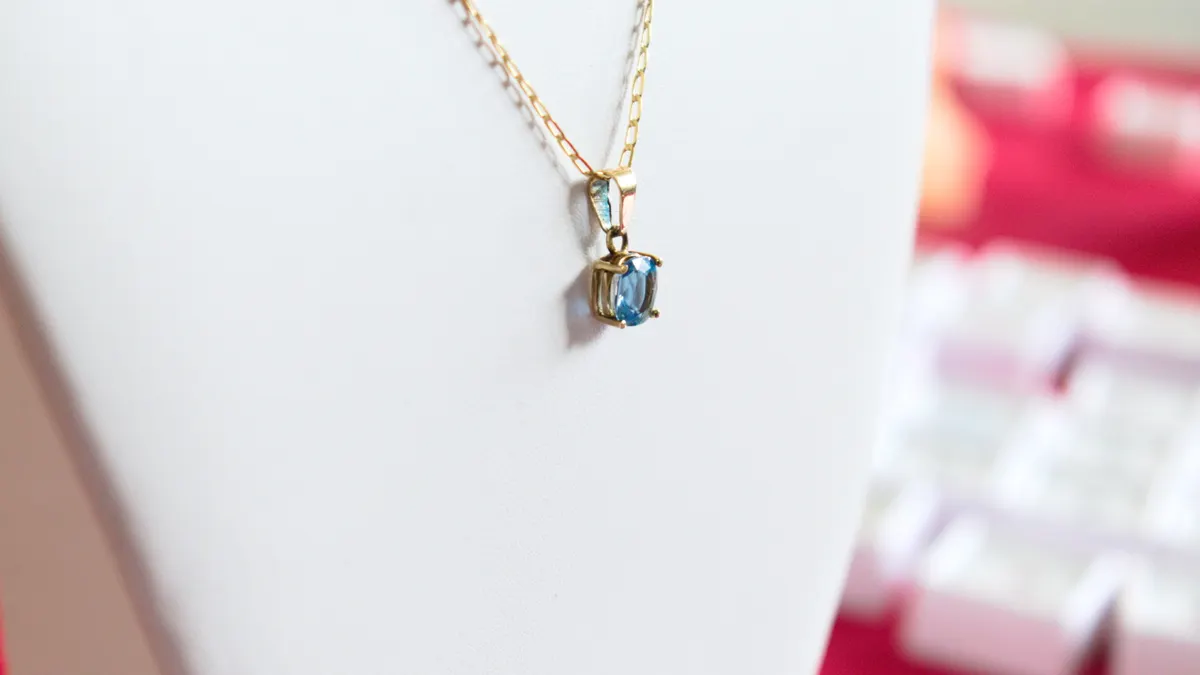
Choose a cable chain if the pendant is the point of the necklace. That is the cleanest recommendation for lockets, initials, gemstones under 1 carat, tiny crosses, and small medallions. A cable chain gives the pendant room to read clearly because the link pattern does not compete with the centerpiece. It also makes replacement easier if the wearer later wants to move the pendant to a different chain.
The specific strength of a cable chain is its neutrality. It works with 16-inch, 18-inch, and 20-inch lengths because the eye goes to the charm first, then to the line of the chain. In a 1.1 mm to 1.5 mm range, it often looks refined without becoming invisible. Above that, it becomes more noticeable, but it still usually stays in support mode.
The weakness is support. A thin cable chain is not the right choice for a heavy pendant, a chunky stone setting, or a necklace worn every day under friction from scarves, coats, or backpack straps. If the pendant yanks the chain forward, the chain may twist or wear faster at the clasp and jump ring.
Choose a curb chain when the pendant is heavier or when the necklace needs a stronger visual anchor. The flatter links hold their shape well and can make a pendant sit more confidently, especially at 18 to 24 inches. A curb chain is also better when the necklace is worn alone, without a pendant, because the chain itself reads as finished jewelry.
The downside is aesthetic balance. A curb chain that is too wide can overpower a small pendant, making the piece look mismatched. It can also feel visually louder on very fine or formal clothing. This is the kind of chain that looks excellent in the right proportion and distracting in the wrong one.
A simple rule helps here:
- if the pendant is delicate, choose cable
- if the pendant has weight or presence, choose curb
How do neckline, body shape, and layering change the choice?
They change it enough that a chain chosen in isolation is often the wrong chain. A necklace does not exist on a white background; it sits against skin, collars, hair, and other jewelry. That is why a chain that looks perfect on a flat product photo can fail in daily wear.
A crew neck usually pairs best with a longer chain, often 20 inches or more, so the necklace can clear the fabric instead of sitting under it. A scoop neck can handle 16 to 20 inches because it leaves room for a shorter focal point. A V-neck usually works best when the necklace echoes the V shape, which often means 18 to 22 inches depending on depth. A turtleneck typically favors 24 inches or longer, or a shorter choker-style necklace if the wearer wants a deliberate close-to-neck look.
Body shape matters less than neckline shape, but it still changes the result. On a shorter neck, a 16-inch chain may sit higher than expected and feel crowded. On a longer neck or broader frame, the same chain may look more open. The necklace should frame the body, not fight it.
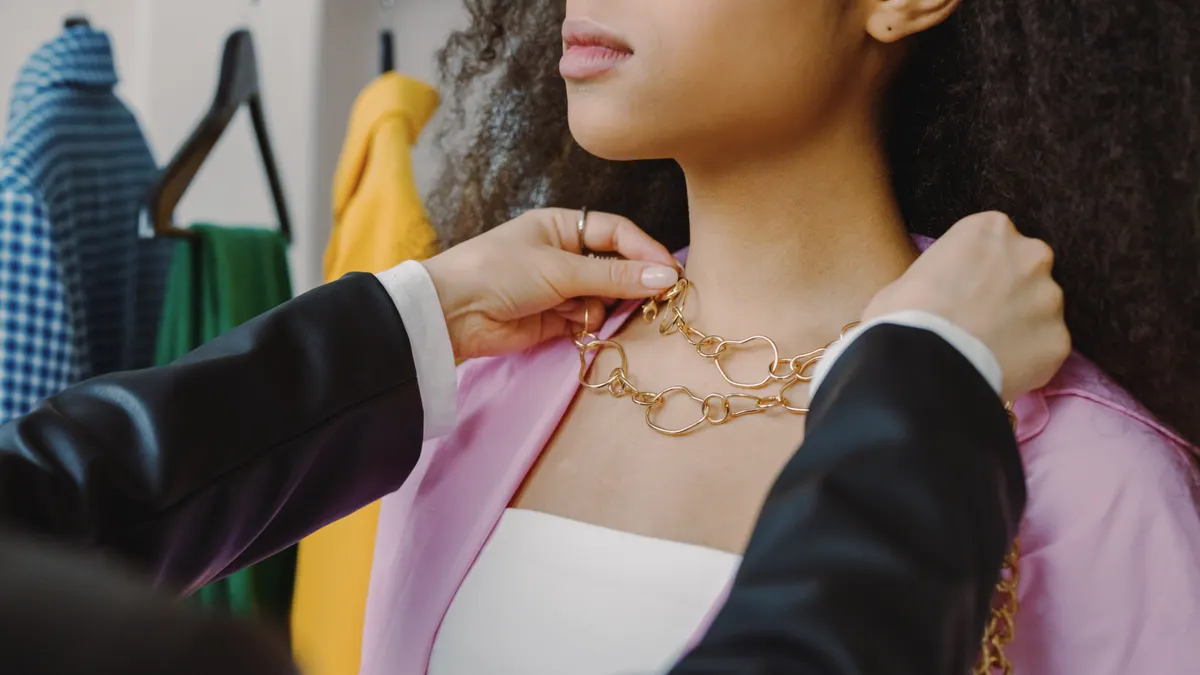
Layering adds another constraint: each chain needs a separate role. A 16-inch chain, an 18-inch chain, and a 20- or 24-inch chain create visible spacing much better than two nearly identical lengths. When lengths are too close, they tangle more easily and lose the layered effect. Different chain textures help too; a fine cable chain layers better next to a curb chain than next to another fine cable chain of the same gauge.
The honest limitation is that not every neckline welcomes every necklace. A person who wears high collars most days will get more use from a 20-inch or 24-inch chain than from a 16-inch one. Someone who wears open necklines may find short necklaces more versatile. If the wardrobe is varied, 18 inches is the closest thing to a universal starting point.
When should you avoid a short chain or a very fine chain?
Avoid a short chain when the wearer dislikes anything tight near the throat, when the neck is broad enough that a 16-inch necklace will ride high, or when the outfit already has a high, structured collar. A short chain can look elegant in the right context, but it is unforgiving. It leaves little room for movement and can pull awkwardly when the wearer turns the head. For people who wear glasses, scarves, or collared shirts, that tight space can become annoying fast.
Avoid a very fine chain when the pendant is not tiny. Fine chains can be beautiful, but they are also the first to show stress from daily handling. If a pendant is heavy enough to swing when the wearer walks, the chain needs enough thickness and strength to support that motion. Otherwise, the necklace may kink, twist, or wear at the links and clasp.
This is where many generic guides go wrong: they focus on appearance and ignore load. A 0.8 mm chain may look delicate and expensive, but it is not automatically suitable for a large pendant. Likewise, a thin, elegant chain can look perfect in a styling photo and feel annoying after an hour of wear if it sits too high or catches on hair.
Another skip condition is frequent layering with rough fabrics. Knitwear, zipper pulls, and textured scarves can snag very fine chains. A slightly sturdier chain, even if less “dainty,” is the better buy when the necklace will be worn often in cold weather or with outerwear.
The trade-off is clear. Short and fine reads refined; it also demands more care and more specific styling. Longer and sturdier is less delicate; it also earns its keep in more real-life situations.
The verdict: which necklace chain and length to choose
Choose an 18-inch cable chain if the necklace needs to work with the most outfits, the pendant is small to medium, and the goal is a dependable everyday piece. Choose a 20-inch curb chain if the chain must carry more visual weight, the pendant is medium to slightly heavy, or the wearer wants a necklace that sits a little lower and feels less restrictive.
Neither choice works well if the pendant is too heavy for the chain, the wearer wants a necklace for constant layering under high collars, or the only available length forces the piece to sit wrong on the body. In that case, change the chain style or length before buying; forcing the wrong fit is the fastest path to a necklace that stays in the box.
The strongest general recommendation is this: for most people, an 18- to 20-inch chain is the best starting range, and a cable chain is the safest first buy unless the pendant is substantial. That combination gives the broadest range of use without looking overly plain. A curb chain becomes the better call when the chain itself should be visible or when the pendant needs more support.
This is a category where “looks good online” is not enough. A necklace that measures right, carries weight correctly, and clears the neckline will get worn. One that misses any of those three is jewelry clutter, no matter how attractive the photo.
When does the choice flip completely?
The overall recommendation flips when the necklace has a special job that breaks the usual rules. A 16-inch chain can be the right choice for a formal, bare-neck look because it frames the face cleanly and keeps the pendant high. A 24-inch chain can be the better choice for a large medallion or a pendant meant to sit over a knit dress because the longer drop gives the piece room to read properly.
The choice also flips for very heavy pendants. In that case, a sturdier chain with a stronger clasp matters more than elegance. A thin cable chain may be the wrong answer even if it is beautiful, because the cost of failure is not aesthetic; it is a broken necklace.
Another flip case is layering. If the wearer plans to stack two or three necklaces, the single best chain is not the one that stands alone best. It is the one that creates spacing. That can mean a short fine chain, a medium chain, and a longer chain in mixed textures rather than one “perfect” chain.
The final flip case is sensitivity or comfort. Some wearers do not want anything close to the base of the neck, full stop. For them, a 22- to 24-inch necklace is not a style choice; it is the only practical choice. In that scenario, the common advice to start at 18 inches becomes the wrong advice.
How to buy with fewer regrets
Buy the length by measuring a chain that already sits where you want it, then match the style to the pendant’s weight. A soft tape measure or even a piece of string will tell you more than a stock model photo. Measure from clasp to clasp on a necklace you already wear, then compare that measurement to the listed length. That avoids the common mistake of assuming every 18-inch necklace will sit exactly the same way.
Check the clasp, the link thickness, and whether the product listing says the chain is hollow, solid, or plated. Those details matter because a necklace can look similar across listings while behaving very differently in wear. A maker’s stated metal type and chain width are more useful than vague wording like “elegant” or “luxury.”
If you want one chain that can do most jobs, start with 18 inches in a cable chain. If you want a slightly more assertive everyday chain, move to 20 inches in a curb chain. For larger pendants or over-clothing wear, go to 24 inches and make sure the chain is built to match the pendant’s weight, not just its style.
For consumers comparing options from different retailers, it is worth checking the current price at the brand site, Amazon, and major jewelry retailers such as Macy’s or Zales, because chain styles and included details can vary even when the length name is identical. The better buy is the one that states actual measurements clearly and matches the necklace’s job, not the one with the prettiest product title.
Drafted with AI; not yet reviewed by a person.